
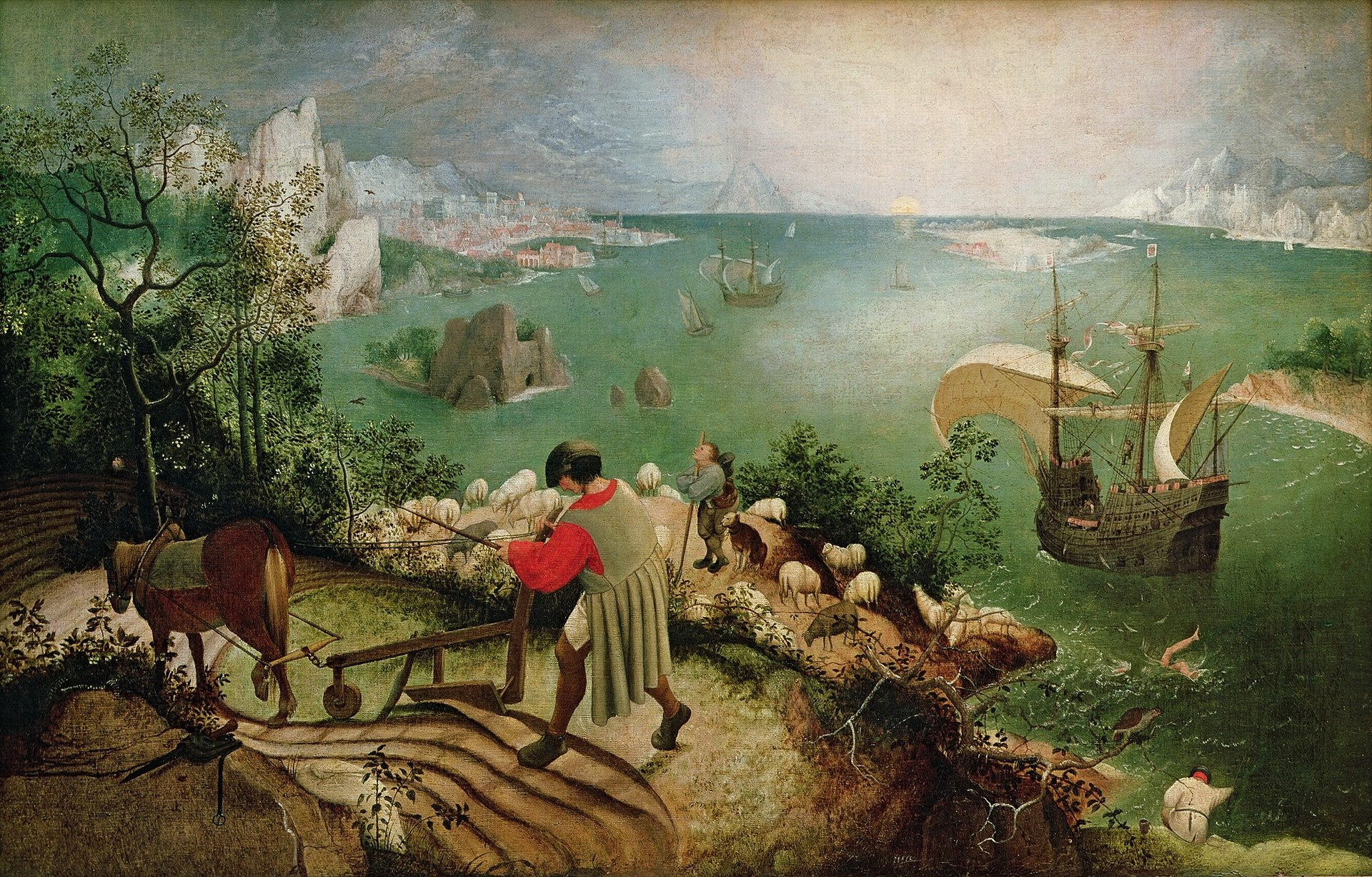
Bruegel painted it; Auden eulogized it; an article by Elisa Gabbert today’s NYT shined a light on it, and I felt it. It’s a musing on a 1560 painting by Pieter Bruegel the elder: Landscape with the Fall of Icarus. It is not an eye-shattering work. The subject matter is simply a day in the life – a farmer plowing, a fisherman fishing, a shepherd gazing, a cargo ship sailing,
Except… for the matter of a body that seems to have fallen from the sky into the sea, legs flailing in the wind before, presumably, drowning.
The sheep graze, the shepherd turns his back from the drama to look skyward toward the forest and dream away. In fact, all characters in this scene have turned their back to the hapless human in the water, including the fisherman who, only feet from the fallen boy, does not stretch for anything but the fish on the end of his line.
It was then, as it is now, a world that sits back and blindly tends to what it can, giving in to a unexamined quotidian existence untouched by the drama around it even if that drama is happening within arms’ reach. Is it the audience that sits through the good part in a movie theater even though someone rows away shouts “fire”? Is it mid 1930s Berlin or Munich, and the Jews are learning to live with curfews? Is it 2021 America going maskless to the mall?
Icarus was not clueless about what was about to happen. He was warned by Dedalus, his father and great inventor of the maze of the Minotaur, that flying too close to the sun would mean certain death. But Icarus kept on flying, soaring closer and closer to the heat until his wings melted off. And then he fell into the sea.
Perhaps this painting is a moral tale that asks if it is your neighbor’s responsibility to keep you if you mastered your own destruction. Perhaps it is a riddle: if a man falls from the sky and there is nobody there to see him, did the man fall at all? Maybe it retells the story of Columbus, whose ships off the Americas went undetected as local inhabitants simply did not have a previous experiences of these specters. Or maybe it is a human parable that asks how we define ourselves if we don’t jump in to save another human life.
There is a lot going on in that painting, and Icarus’s tragic, foolish death is just one of them. But none of the characters seem to be aware or connected to any other, as if it is an anytime crossing of Times Square where only the street itself connects the players. Recent photos of Russian citizens in various queues – heading down a metro escalator or trying to pull rubles out of the ATM before they disappear — frames a portrait of a people unphased, each staring into the scrolls on their phone, and going on with the day’s business while apartment buildings explode and populations vaporize just 500 miles away. That would be like Los Angeles going to the beach while San Francisco crumbles. And sadly, that scene is not out of the realm of eventualities.
I walk through this Bruegel painting nearly every day. My street paths are places for homeless, mostly men, as they set up their camps and wander dazedly in rapt conversations with themselves. I do not lend a hand or tip a hat. I stay fixedly on my path seeing nothing. I watch news about unfolding horrors, read the headlines, have the conversations. But I do little or nothing to effect any action, however small, on their behalf. There are legs flailing in the water. Isn’t there a ship nearby?
Musée des Beaux Arts (1940)
W.H. Auden
About suffering they were never wrong,
The Old Masters: how well they understood
Its human position; how it takes place
While someone else is eating or opening a window or just
walking dully along;
How, when the aged are reverently, passionately waiting
For the miraculous birth, there always must be
Children who did not specially want it to happen, skating
On a pond at the edge of the wood:
They never forgot
That even the dreadful martyrdom must run its course
Anyhow in a corner, some untidy spot
Where the dogs go on with their doggy
life and the torturer’s horse
Scratches its innocent behind on a tree.
In Breughel’s Icarus, for instance: how everything turns away
Quite leisurely from the disaster; the ploughman may
Have heard the splash, the forsaken cry,
But for him it was not an important failure; the sun shone
As it had to on the white legs disappearing into the green
Water; and the expensive delicate ship that must have seen
Something amazing, a boy falling out of the sky,
had somewhere to get to and sailed calmly on.
March 2022