When I last visited Tunisia it was 1984. The government had chosen to end subsidies on wheat and semolina and bread. The public rose up, people were killed, political discussions happened in whispers against peeling walls of limestone and coral. Jobs were scarce, women wore veils and the poor were getting poorer. But something odd was afoot. Women in Tunisia were granted a constitutional right to seek contraception and abortion. A few years later, General Zine El Abidine Ben Ali came to power in a coup, severely curtailing rights of the populace but still allowing women to remain firmly in charge of their bodies and with equal status among men.
Decades later, the Arab Spring of 2011 saw the ouster of the General and the entrance of continued weak leadership and economic stagnation. Tunisians had been stripped of their privileges, such as free speech and the right to protest in barely perceivable increments – the frog in the heating pot of water.
Last week frog died. Tunisians, in a last gasp of democracy that drew disputedly low turnouts at the Cathagian polls, approved a new constitution that effectively cements the one-man rule instituted by current President Kais Saied. This may not have been the Arab Spring Tunisians expected.
The Tunisian leader is a strict constitutionalist and this new constitution allows him to rule by decree, jailing and restricting opponents through rubber-stamp military courts, pausing parliament and adopting broad emergency powers.
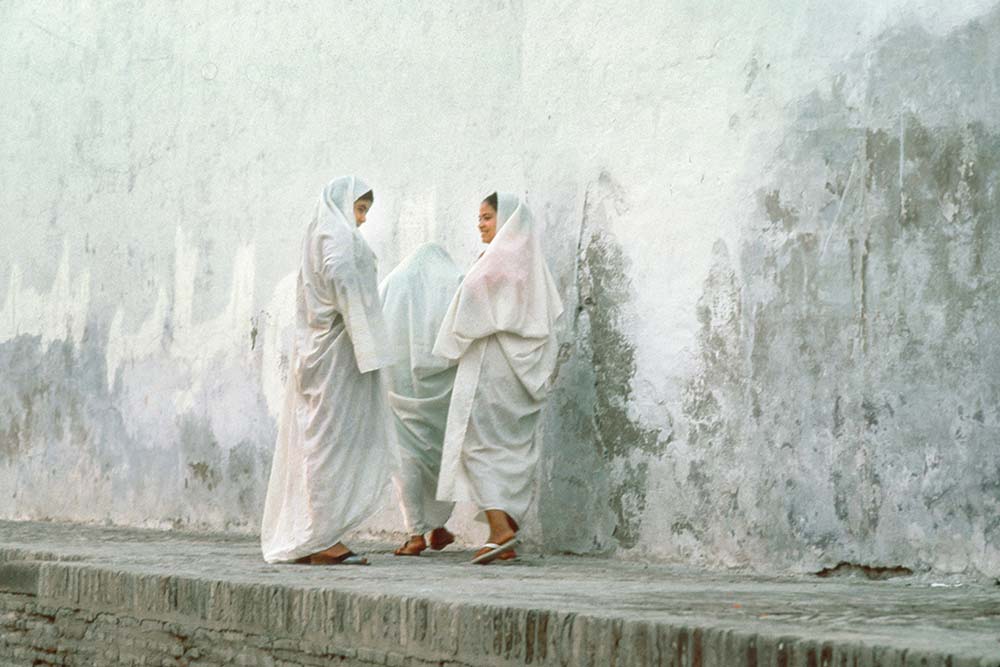
In my brief time in Tunisia during similar upheavals with different overtones, I found a certain innocence along those pitted dusty streets. I traveled there with photographer Ilene Perlman to unearth an unsung community of Maghreb Jews from another century living in a strange fairytale on the island of Djerba, a dot on the coast on the way to Tripoli. In Tunis we wandered the souks and covered alleys now lined with the telltale 1950s North African urban design brought by the French in post-independence trade agreements. Shops were modest – mostly fruit stands and cafes advertising chakchouka with pommes frites. Hilton and Marriott had yet to find a foothold in Northwest Africa. Ladies smiled shyly through white cotton wraps that looked like bed sheets and most of the men walked in white turbans and white flowing robes. We did not see tourists. We were taken for French workers as if we had lived there for decades.
As we hung out with the Jewish women of Djerba, they opened up to us within halting French exchanges. We did not ask about politics, about what it was like to live under a curiously unstable government, about whether these women were allowed to be educated or what they wanted for their lives. Rather we laughed and giggled about simple things – the single wire “eruvs” surrounding their houses to protect from outside influences – namely gentiles, and the seating in the synagogue that was divided by gender. On Djerba, a backwater first described in The Odyssey as what was possibly the Land of the Lotus Eaters, such overarching topics of the day were not the concern. The island had an airport, a French Club Med (and yes, to the delight of all the camel wranglers offering must-do rides on the beach, clothing was optional), and a few short blocks for a central village. But it also had a synagogue.
In fact, Tunisia had only recently shed the beys and the veils with a lion’s-leap into the 20thcentury. And in a strange holdover from another time, there seemed to be an undisturbed glimmer of Jewish life. The country contained a significant Jewish minority presence since Roman times and possibly before that. In 1948, the Jewish population was an estimated 105,000 – down to about 12,000 during the 1980s. By 2012, some 1,000 Jews remained on that island and counted for the country’s largest indigenous religious minority.
The independence movement of 1956 that wrested the country from French rule put all Tunisians on an independent footing and bannished Sharia law from the constitution. The women in Djerba’s insular and isolated community of Jews did not wear veils, were freely educated and went to synagogue with their families without fear of bombs or terrorists, all along practicing forms of Judaism dating back to Biblical times. It is said the El Ghriba Synagogue is built on stone from Solomon’s temple.
As the PLO set up headquarters in Tunis in the 1980s and Hamas leaders later began using Tunisia as a way to strengthen their numbers, the Jews of Tunis and Djerba fled. An Al Qaeda-claimed terrorist bombing at El Ghriba in 2002, which killed 21 and injured 30, put a seal on that fate. While the few residents who call Djerba home still use the synagogue, it is now mostly open by appointment to visitors and tour companies from time to time for those who bother to come this way.
But Tunisia is no longer a country frozen in time, an island of pleasant forgetfulness. Woke by the force of last week’s constitutional referendum and confronted with a leader who talks but doesn’t listen, who invents new sets of rules and the stories to justify them, and then sticks to these rules like a priest to a Bible, the people of Tunisia may be one more country in a burgeoning list experiencing fewer rights, fewer economic options and worsening food shortages under yet another strong man evangelizing for himself.
At one time admired for its liberal policies and its bold women’s equality stance, those, too, will likely be stripped away – as they have been in the U.S. – because they can be. Freedom of speech will soon become an ideal seen in name only as restrictions are placed on information distributors and protests are quelled with force. We won’t see it immediately for that is not the pace of history. That is not the way of the frog. The tiny sleepy nation on the north shelf of Africa has a voice. Listen for it and weep, for this could be the siren song of our destiny too.
Photo by Ilene Perlman