
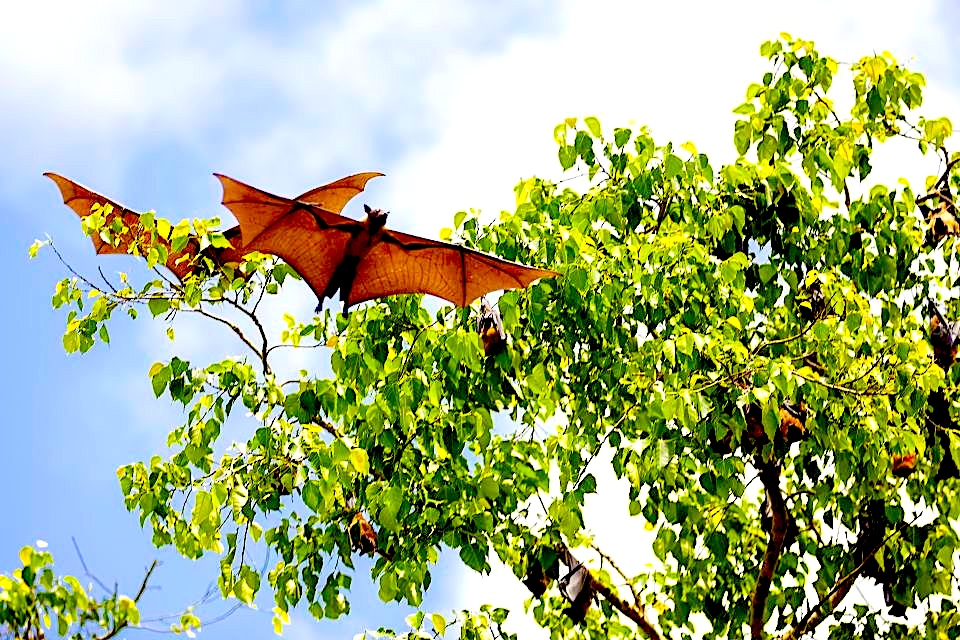
We trudged off to the land beyond our oceans to find rare bats that were bigger than basketball players. We also targeted four-eyed fish with bone structures that pre-dated the dinosaurs and a rare flower emitting a scent rumored to calm all ills. We found it all in the Comoros, an island chain in the Indian Ocean I knew from one obscure film, Lorenzo’s Oil. It was enough to seek out a plane ticket.
What I did not know before I arrived was that the islands marked the location of continuous coups and disappearing airlines. We were not young but we were still undaunted by things that couldn’t be done easily … hard travel that leaves you dangling into stories you will tell someday, maybe to some kid with wide eyes.
As we made our way across the world, landing in Johannesburg, Ilene grabbed her camera equipment for random shots of white suburban South Africa in the mall-choked city of Sandton. We edged our way through Woolworths for back-up sandals and maybe an umbrella. The Comoros islands, still somewhat French, would not have supplies outside of what could be imported through Grande Comore Island’s one tourist resort.
Our plane landed in Madagascar and could not take off again for the onward route before the interiors had been thoroughly doused with DEET deadly enough to kill a small animal. And then it happened again as we left Rodrigues. We could only imagine the size and scope of the insects we were warding off. I had lived in these parts off and on and met mantises bigger than my hand and camel spiders that could fill a shoebox. Even the cockroaches were too big to squish.
We made our way from the one-room airport in Hahaya to the resort and the main town of Moroni nearby. There was food at this hotel – buffet-style. In fact, everything was about food. The restless bats that lined branches and dive-bombed through the trees and alleys were the size of small dogs and were active at all hours – flying foxes with two-foot wing spans and little round bellies from all the abundant fruit.
The taxi driver who bothered to take us explained it this way: “Why should we work when there are so many fish that leap from the sea and so much fruit just there, just to take?” Indeed, there was a dearth of drivers and cars or anyone manning a desk. The market area served mostly a gathering spot for women to gossip and sell whatever fruit they had picked.
The hotelier we spoke to noted that hiring staff and keeping them was a difficult task on this island. “People here will work for a few days and get money for materials to add a brick or a window or a door and then we won’t see them again for a while.”
The entire island was pocked with half-built houses of cinderblock and coral sand. Some had thatched roofs, others had tarps or tin, all tucked away into the teaming vines, the wild banana bushes and the towering jackfruit that dropped pulpy pods the size of bowling balls to the delight of the monkeys and lemurs.
I had no idea how we would begin. We were on a mission – a magazine assignment I had pitched — to find orchards of ylang-ylang, an odorous flower from the rare Cananga tree that is used in the finest perfumes. Around these parts it is employed to promote relaxation, kill bacteria, lower blood pressure, and increase sexual libido, cure depression … and probably clean windows. Head lice don’t stand a chance. The smell supposedly helps memory and boosts thinking skills, according to the lore. I was in. They had me at head lice. So, we needed to find the distillers of this flower and watch the magic unfold in vats filled with the petals and contraptions that would reduce the cache to trickles of dripping vapor amassed and processed or simply sold in its pure form. Who were the farmers? The distillers? The buyers? Where were the markets? Who were the users?
Ilene would be catching what could be made interesting on film – yes, it was film in those days. And I would wade through headaches of broken French and some sort of island pigeon to jot down a sequence of information that could be molded into a story or some kind of reason for us to have come all this way. We asked the taxi driver to take us to such a place. We always asked the taxi driver.
We found a distillery: shack surrounded by a phalanx of metal vats and small pots over wood fires. “It is good for your stomach and good for your headache,” said the hapless producer suddenly invaded by two strangers who wanted to know everything he could tell them about the mess in his yard. We peered into the vats and saw piles of the delicate flower preparing to be boiled into a froth that would condense into one drop followed by another and another to make maybe a slow quart of heady elixir. It takes 400 kilos (more than 800 pounds!) of tiny ylang-ylang blossoms distilling for some 10 hours to make one kilo or 2.5 pounds of oil. Blossoms take three to four years to appear on the small tree, which also grows here and there in the Philippines, New Guinea and the Solomon Islands.
This island, this place is one of the last places on earth the plant is grown and gently turned by hand into liquid gold, an oil that sells for as much as $40 an ounce. For the farmer, however, gold was as elusive to him as a Chanel #5 ad. His business was a subsistence model, his vats held enough pickings to keep his neighbor’s headaches in check and a roof on his fully-built house.
The flying foxes chattered and swooped, long-nosed faces like cartoon characters out of some 1950s Popeye series with big noses and beady eyes that looked right at you. And we walked on jungle roads we came upon a child starring, simply staring. She could not have been more than eleven. She played in the thick yards, sun almost melting the turmeric mask she wore on her face for protection. She did not invite us in to her stone and coral abode. Rather, she stood there looking at us, not afraid but frozen just the same, her thin bare legs and feet ready to spring like a scared feral cat. But she did not run. Rather, she watched us perhaps wondering if we were the next coup makers or whether we bore fruit of our own.
We continued this way, gravel roads, unfinished houses, that occasional group of girls or women that would stop in their tracks and stare. The Comoros Islands do not get many visitors. The resort on Grande Comore was inhabited by French nationals and those doing business with the island. No one was there for a tour.
But I was there for my own tour and next up? Four-foot Crustacean Age fish and the car-sized bats. Ilene was not so sure. Her specialty veered to faces not freakish animal life. There were none of the usual crowding, laughing children to photograph. The older women wrapped in decorative cotton cloth did not mind so much. They sat together lining the shallow stone wall to the harbor. Above them the flying foxes sat together on the wires that brought electricity to the town. All was a bustle. The chatter was deafening.
The taxi driver could not take me to any fishing spot bearing the elusive, 420 million-year-old coelacanth. The only coelacanth on the island could be seen in a museum, mummified under glass in whole form, all four feet of it, looking more like a lost salamander out of a Jules Verne story or ichthyosaur from a children’s encyclopedia. And as for the elusive six-foot bat, the Livingstone bat, we would find them on the island Anjouan nearby, the taxi driver told us. It lives deep in the rainforest there. Few have seen them.
We decided to take our chances and set off on a small 18-seat bombardier jet for the island that time forgot. Anjouan was only 30, maybe 20, minutes from Grande Comore but cut off from the world otherwise. Its volcanic cone-like geography ensured there was plenty of interior jungle that would remain that way.
A young boy in his early teens caught onto us and quickly made himself into our eyes and ears on the island. Bats? He said, you want to see the bats? I will take you there. Off we went in a taxi from the small bush port to find the venerable Livingstone bat. The compact French car curved and wound and careened through dirt roads or paths into a land that was darkening even though the afternoon sun glinted off the ocean. Trees became thicker, taller, fuller. Blue sky turned a dusky grey. Roads became more curvy and slow and bumpy and suddenly the ylang-ylang odor that now inhabited my backpack filled the air with its sweet and heady scent turned the car into a schooner pitching on angry seas.
I stopped the car and let out all the past few days of strange eating – overloading on wild fruit, sampling white meaty fish from the bay, those French wines. I would never be able to breathe the essence of ylang-ylang without a glimmer of nausea and remembering the bats I never found.
We left Anjouan the next day – or tried to. Our scheduled plane was hours late and when it did show up, we were told it would not fly. Apparently someone did not bother to pay the invoices and the plane was going away. I tried to wrap my thoughts around what was unfolding in front of me and the prospect that I might be stuck on Anjouan, marooned on an island far from anywhere, far from this century, far from the echoes of anything I knew.
But even bankrupt airlines have to get their craft back to civilization. We made a small scene to get past the gate clerk and swooped in to take our seats for this one last ride the plane would make, savoring the half-hour flight back and looking forward to the insect repellent stops on neighboring islands beyond. And we had our booty in tow. We had seen bats the size of flying babies and came back with vials of ylang-ylang oil that I would never be able to uncork. We bid adieu to four-foot fish and six-foot bats and probably a few hidden raptors yet to be discovered.
As we left the Comoros Islands we were informed that yet another coup had taken place. The trees have fruit and the bay is full of fish. On this island that was all that mattered.
Photo by Ilene Perlman